
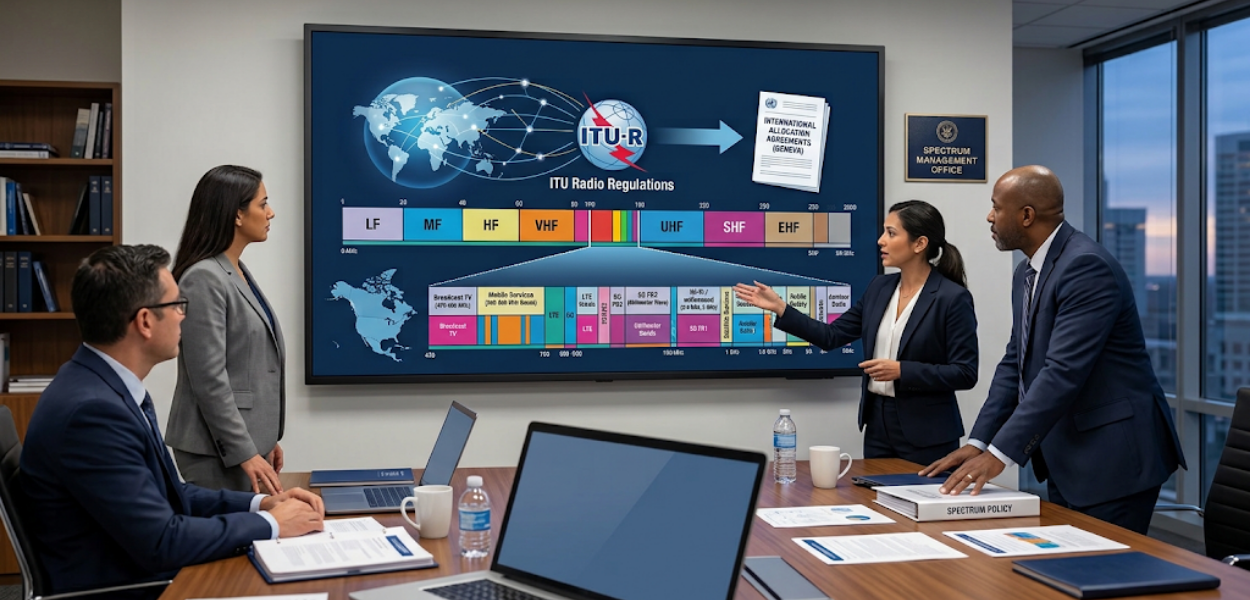
Radio frequencies do not stop at a border. A broadcast signal transmitted in one country can degrade a mobile network in the next if nobody coordinates who transmits where. Spectrum management exists to prevent exactly that outcome, and it operates on two levels at once: an international rulebook maintained by the ITU, and a national table that each country builds from that rulebook.
For engineers, regulators, and telecom operators building this capability from the ground up, the starting point is usually foundational: understanding how monitoring stations detect unauthorised transmissions, how frequency bands are structured, and how allocation differs from assignment. Teams new to the discipline typically build this base through Spectrum Management and Radio Monitoring Training Courses, which cover the technical vocabulary and monitoring techniques referenced throughout this article. Once that foundation exists, the harder question becomes operational: how a national administration turns an international table into an enforceable domestic licensing regime.
What is spectrum management, and why does it require international coordination?
Spectrum management is the process of allocating, assigning, and monitoring radio frequencies to prevent interference between services, and it requires international coordination because radio waves cross borders regardless of national boundaries.
Radio spectrum runs from 8.3 kHz to 3000 GHz, and every band within that range carries capacity for a limited number of simultaneous, non-interfering users. Two transmitters operating on the same frequency in overlapping coverage areas degrade each other's signal. Because HF and VHF signals propagate for hundreds or thousands of kilometres, a country cannot manage its spectrum in isolation. The International Telecommunication Union, a United Nations specialised agency, produces a single international reference to prevent this conflict: the Table of Frequency Allocations, published as Article 5 of the ITU Radio Regulations. Every ITU member state uses this table as the basis for its own national frequency planning, which keeps cross-border interference within manageable limits and allows equipment manufacturers to design radios that work across multiple markets.
What do the ITU Radio Regulations actually govern?
The ITU Radio Regulations are a binding international treaty defining which radio services may use which frequency bands, under what conditions, and in which of three world regions, updated every three to four years.
The Regulations cover more than 40 radiocommunication services, including fixed links, mobile networks, broadcasting, satellite systems, radionavigation, and radio astronomy. Article 1 defines the terminology used throughout the treaty. An allocation is an entry in the Table permitting a service to use a band. An assignment is the authorisation given to a specific station to operate on a specific frequency. An allotment sits between the two, reserving a frequency or channel for use by one or more administrations within a defined geographical area. This distinction has operational weight. A government does not assign spectrum directly from the international table. It confirms the band is allocated to the relevant service first, then issues assignments through its own licensing process. World Radiocommunication Conferences revise the Regulations on this three-to-four-year cycle. WRC-19 identified millimetre-wave bands above 24 GHz for 5G deployment, and WRC-23 addressed 6 GHz spectrum sharing between Wi-Fi and mobile broadband, showing how the treaty adapts to new technology demand without discarding its original structure.
How does Article 5 structure the international Table of Frequency Allocations?
Article 5 lists every frequency band from 8.3 kHz to 3000 GHz against the radiocommunication services permitted to use it, distinguishing primary from secondary status and separating entries by region where global agreement is not possible.
Services within Article 5 are classified as primary or secondary. A primary service has priority: it can claim protection from harmful interference and cannot be required to accept interference from other services sharing the same band. A secondary service must not cause interference to a primary service and cannot claim protection against one. Some bands carry exclusive allocations, reserved for one service worldwide. Others carry shared allocations, allowing multiple services to coexist within the same band under defined technical conditions. Footnotes attached to specific entries add further constraints, restricting use to particular countries, technical parameters, or time periods. National regulators reproduce their region's column of Article 5 as the starting point for domestic frequency tables, then layer national footnotes on top to reflect local priorities.
Why do the three ITU regions have different allocations?
The ITU divides the world into three regions for spectrum planning because a single global allocation for every band proved impractical; Region 1 covers Europe, Africa, the Middle East, and the former Soviet states, Region 2 the Americas, and Region 3 Asia-Pacific.
A band allocated to one service in Region 2 can carry a completely different allocation in Region 1. The 902–928 MHz band illustrates this. In Region 2, it is allocated for industrial, scientific, and medical use and carries unlicensed devices such as LoRa-based sensors. In Region 1, the same range is used for railway mobile communications and is not available for unlicensed devices. A device certified for one region cannot be assumed compliant in another. This regional split reflects historical spectrum use, existing infrastructure investment, and national priorities that could not be reconciled into one worldwide table without disrupting services already operating in each region. Regulators and network planners working across regions treat this variation as a standing constraint on equipment procurement and roaming design.
How does a national frequency allocation table relate to the ITU table?
A national frequency allocation table takes the relevant regional column of Article 5 as its baseline, then adds national footnotes, service priorities, and licensing categories reflecting the country's own infrastructure and policy objectives.
Uganda's National Table of Frequency Allocation reproduces Region 1's Article 5 entries in one column, then lists Uganda-specific allocations and licensing notes in adjacent columns. Nigeria, also in Region 1, built its most recent major revision on a national frequency spectrum audit combined with the outcomes of that year's World Radiocommunication Conference. Jordan's table follows the same pattern, reproducing Region 1 entries and Region 1 footnotes before adding national conditions. This structure repeats across ITU member states: reproduce the regional allocation, then localise it. National administrations revise this table periodically, particularly after each WRC, to keep domestic policy aligned with the updated international treaty while accommodating services such as 5G, satellite broadband, and IoT connectivity that earlier allocations did not anticipate.
What role does spectrum monitoring play in enforcing frequency allocations?
Spectrum monitoring verifies that transmitters operate within their assigned frequency, bandwidth, and power limits, using frequency measurement, occupancy measurement, and direction finding to detect unauthorised use and locate sources of interference.
A national frequency table has no enforcement value without a monitoring capability behind it. Monitoring stations perform six core measurement tasks defined in ITU-R recommendations: frequency measurement, field strength and power-flux density measurement, bandwidth measurement, modulation measurement, spectrum occupancy measurement, and direction finding. Occupancy measurement records emissions across a frequency channel over a defined period, producing usage statistics that inform whether a band is congested enough to justify reassignment or additional licensing. Direction finding locates the physical source of a signal by comparing its angle of arrival at multiple receiving points, the technique used when tracking down an unlicensed transmitter or a device causing harmful interference to a licensed service. Interference hunting combines both: occupancy data confirms a problem exists on a given frequency, and direction finding narrows it to a physical location. The ITU Handbook on Spectrum Monitoring sets performance benchmarks for this equipment, including antenna accuracy and receiver sensitivity, so monitoring stations across different countries produce comparable, defensible results.
Where does licensing fit into the allocation-to-assignment process?
Licensing is the administrative step converting a national table allocation into a legal right for a specific operator to transmit on a specific frequency, and it depends on accurate monitoring data to remain enforceable.
Once a band is allocated to a service in the national table, the regulator can issue assignments within that band to individual applicants. A licence specifies frequency, bandwidth, power limit, geographic coverage, and duration. Issuing a licence without checking existing occupancy in that band risks authorising interference between two licensees, undermining the allocation structure it depends on. Regulators increasingly use automated spectrum management systems combining the national table, licensing records, and live monitoring data in one platform, flagging conflicts before a licence is issued rather than after interference is reported. Building and maintaining these systems calls for staff who understand both the regulatory framework and the software layer running the databases and monitoring interfaces behind it, a combination typically developed through Information Technology and Programming Courses alongside the regulatory training itself.
Explore More Expert Insights:
Satellite Communication Systems: Orbits, Transponders and Footprint Coverage Explained
Radar Systems: Range Resolution, Doppler Shift and Radar Cross Section Explained
What capability gap prevents organisations from managing spectrum compliance effectively?
Most organisations understand the concept of frequency allocation but lack staff who can apply Article 5, interpret national footnotes, and operate monitoring equipment to the standard regulators expect, which is a structured skills gap rather than a knowledge gap.
Telecom operators, broadcasters, and government agencies typically employ engineers who understand radio propagation and equipment configuration. Fewer employ staff who can read a national frequency table alongside its regulatory footnotes, correctly classify a service as primary or secondary, and defend a licensing decision against an ITU or regional audit. This differs from workforce skill gaps in adjacent fields, where a single self-paced module closes the gap. Spectrum regulation requires supervised technical practice on monitoring equipment and applied reading of live national footnotes, which favours instructor-led, lab-based delivery over self-paced formats. The gap shows up during spectrum audits, cross-border interference disputes, and WRC preparation cycles, when an administration needs staff able to represent its position with the same regulatory fluency as the international delegates it is negotiating with. HR and L&D teams commissioning this training typically measure return through audit outcomes and licensing accuracy rather than completion rates: fewer licensing conflicts, faster WRC preparation cycles, and reduced dependence on external consultants during interference disputes. Closing this gap requires training built around the same regulatory knowledge that regulators themselves apply day to day, not generic radio engineering content. Organisations addressing this directly typically move through a programme such as Take Charge of Spectrum Management with Regulatory Knowledge Regulators Themselves Expect, structured around Article 5 application, national table interpretation, and monitoring operations rather than general telecommunications theory.