
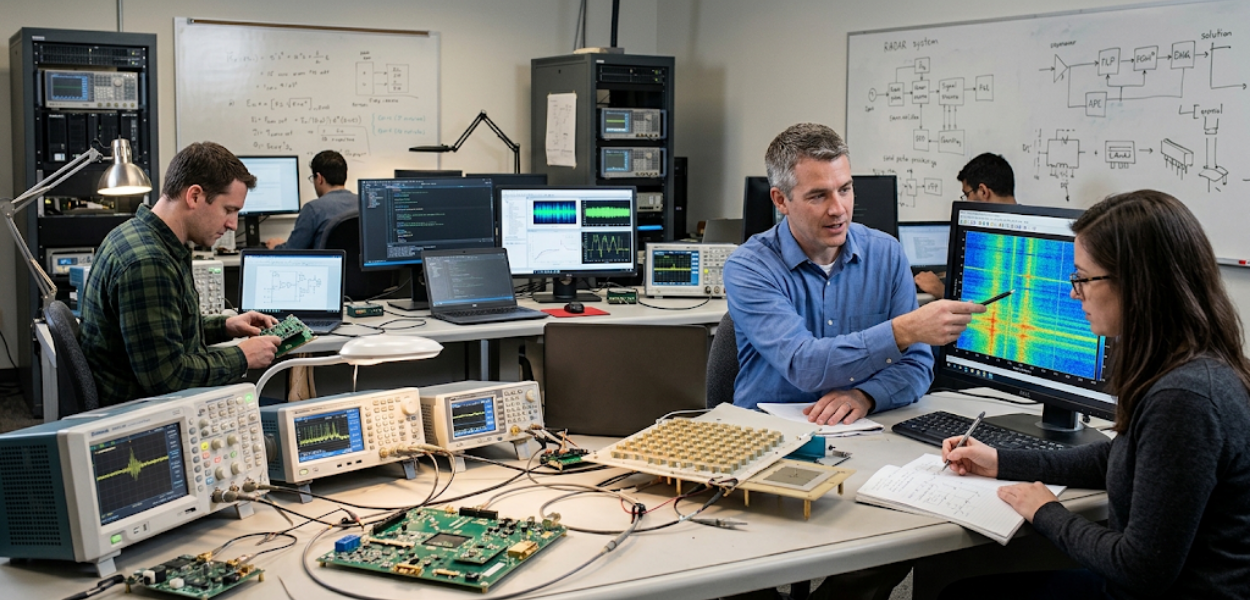
Radar professionals need more than theoretical knowledge of detection, transmission, and signal behaviour. They need structured technical capability to analyse system architecture, evaluate signal quality, understand range and velocity measurements, and identify processing limitations. The British Academy for Training and Development addresses this requirement through a specification-led programme covering radar architecture, pulse compression, Doppler analysis, radar cross section, matched filtering, clutter rejection, and performance optimisation.
For professionals establishing their technical foundation, Radar Systems and Signal Processing Training Courses provide the broader learning context before participants move into advanced evaluation and application.
What problem does the radar systems and signal processing course solve?The programme addresses gaps between theoretical radar knowledge and workplace application by developing structured skills in system architecture, signal analysis, detection, range resolution, Doppler interpretation, clutter management, and performance evaluation for technical professionals.
Radar systems combine transmission, reception, propagation, detection, measurement, and digital processing. A weakness in any one area can affect interpretation of system performance. Engineers may understand individual concepts but still require a structured framework for connecting waveform characteristics with detection results.
The British Academy for Training and Development structures the programme around these connections. Participants progress from radar fundamentals towards signal processing and performance analysis. This allows technical teams to examine how system parameters influence operational results rather than studying each concept in isolation.
The programme is particularly relevant where organisations operate sensing, surveillance, aerospace, aviation, telecommunications, wireless, or technology systems. It can also support technical managers who need sufficient radar knowledge to evaluate engineering requirements and communicate effectively with specialist teams.
Why is the curriculum structured around progressive radar engineering skills?The curriculum follows a technical progression from radar architecture and signal generation to processing, detection, tracking, and optimisation, allowing participants to build each capability on previously established principles and apply concepts to workplace engineering requirements.
The first stage establishes system understanding. Participants examine transmitters, receivers, antennas, processing units, signal paths, and system configurations. This creates the technical foundation required to interpret later processing modules.
The second stage addresses signal behaviour. Frequency, bandwidth, pulse duration, pulse repetition characteristics, and sampling are considered in relation to radar performance. Participants can therefore connect waveform decisions with detection and measurement requirements.
The third stage introduces processing techniques. Pulse compression, matched filtering, Doppler processing, and digital signal processing are studied as mechanisms for extracting useful information from received signals.
The final stage integrates detection, tracking, clutter rejection, and performance optimisation. The British Academy for Training and Development uses this progression to keep technical learning connected to system-level requirements. The structure also allows organisations to identify specific capability areas for individual engineers or technical teams.
What will participants learn about radar systems and signal processing?Participants develop measurable knowledge of radar architecture, waveform characteristics, pulse compression, range resolution, receiver processing, Doppler shift, radar cross section, clutter rejection, digital signal processing, detection, tracking, and performance optimisation.
Radar architecture and signal generationParticipants begin by examining how radar subsystems operate together. They study transmission and reception, antennas, receivers, transmitters, processing units, and output functions. The objective is to understand the complete signal path rather than isolated components.
Signal generation follows this foundation. Participants examine frequency, bandwidth, pulse duration, pulse repetition frequency, and related characteristics. These parameters are evaluated against detection, target discrimination, and ranging requirements.
Pulse compression and range resolutionPulse compression receives dedicated attention because it connects waveform design with resolution performance. Participants examine how bandwidth and processing gain affect the ability to distinguish targets at different ranges.
Range resolution is treated as a measurable engineering consideration. Participants analyse the relationship between pulse characteristics, bandwidth, and target separation. This provides a basis for assessing whether a radar configuration meets a stated range requirement.
Matched filter processingThe receiver module introduces noise, filtering, sampling, detection, and matched filter principles. Participants examine how matched filtering can improve the detectability of known signal structures within noisy environments.
The learning outcome is practical interpretation. Participants should be able to explain why receiver processing affects detection reliability and how processing choices relate to signal characteristics.
Doppler shift and velocity measurementDoppler shift provides information about target movement. Participants examine how movement produces measurable frequency changes in returned signals and how Doppler processing can support velocity estimation.
The programme also connects Doppler information with moving-target detection and tracking. This allows participants to distinguish the roles of range-related and velocity-related measurements within radar processing.
Radar cross section and target detectionRadar cross section is examined as a factor affecting returned signal strength and target detectability. Participants consider target size, shape, orientation, material characteristics, frequency, and operating conditions.
This module helps professionals interpret why different targets can produce different radar returns. It also supports more structured analysis of detection performance.
Clutter rejection and interference managementUnwanted returns can reduce detection performance. Participants study environmental and operational clutter sources and examine signal processing approaches for separating relevant target information from unwanted signals.
The British Academy for Training and Development places this topic within the wider performance framework. Clutter rejection is therefore considered alongside detection, signal quality, processing efficiency, and operational requirements.
Digital signal processing and performance analysisThe programme then connects radar principles with digital signal processing. Participants examine sampling, digital filtering, frequency-domain analysis, spectral processing, detection algorithms, and data interpretation.
The final technical stage addresses performance optimisation. Participants assess detection capability, range resolution, Doppler sensitivity, signal quality, clutter conditions, processing efficiency, and system configuration.
How does the course convert technical knowledge into workplace capability?The training connects each technical concept with engineering analysis, system evaluation, and operational application, enabling participants to use radar principles when reviewing requirements, analysing performance limitations, troubleshooting systems, and supporting technical decisions.
A radar engineer may use range-resolution principles when evaluating target-separation requirements. A signal processing specialist may examine matched filtering or Doppler processing when assessing detection performance. An RF professional may use radar signal knowledge when working across related wireless technologies.
Technical managers can also use the course to understand the engineering implications behind system specifications. This supports clearer communication between engineering, operations, project management, and technology teams.
The British Academy for Training and Development designs its corporate programmes around practical professional requirements. Participants therefore study concepts in a sequence that supports application rather than treating theoretical knowledge as the final learning objective.
How is the radar training delivered and assessed?The programme can be structured through instructor-led technical workshops, online learning, hybrid delivery, or onsite corporate sessions, with practical exercises, technical assignments, simulations, tests, and performance-based activities supporting knowledge verification.
Delivery can be adapted to organisational requirements. Individual professionals may use an online or instructor-led format, while technical departments can use onsite or hybrid delivery for group development.
Workshops can focus on technical explanation followed by structured analysis. Online sessions can support distributed teams and provide access to learning resources without requiring all participants to be physically present.
Practical activities should connect radar concepts with technical scenarios. Participants can analyse waveform characteristics, examine range-resolution requirements, interpret Doppler information, assess radar cross-section factors, and review clutter-related detection problems.
Assessment can include knowledge tests, module assignments, scenario analysis, simulations, and a final performance exercise. These methods allow organisations to evaluate whether participants can apply concepts rather than simply recall terminology.
The British Academy for Training and Development can structure delivery around the technical baseline of the participants. This is relevant for mixed teams where engineers, technical managers, operations personnel, and signal processing specialists enter the programme with different levels of prior knowledge.
Who is eligible for the programme?The programme is intended for radar engineers, system engineers, telecommunications professionals, RF and microwave specialists, signal processing professionals, aerospace and aviation personnel, technical managers, research teams, and radar operations or maintenance staff.
Participants should ideally have professional exposure to engineering, telecommunications, electronics, radar, wireless systems, signal processing, or a related technical discipline.
The course can also accommodate technical managers who require a structured understanding of radar performance without specialising in every engineering implementation detail. Their learning pathway can emphasise system architecture, performance indicators, technical requirements, and decision support.
Research and development professionals can use the programme to strengthen analysis capabilities when working on sensing, wireless, RF, or signal processing technologies.
Maintenance and operations personnel can benefit from understanding system behaviour, signal quality, processing requirements, and performance indicators. The British Academy for Training and Development therefore positions the programme for multidisciplinary technical environments rather than a single professional role.
What measurable results should organisations expect?Successful participants should be able to analyse radar architectures, evaluate signal characteristics, explain key processing techniques, assess range and velocity measurements, interpret detection factors, examine clutter effects, and contribute more effectively to technical performance decisions.
Learning results can be evaluated against defined workplace competencies. A participant should be able to explain the relationship between bandwidth and range resolution, describe how Doppler shift supports velocity measurement, and identify factors affecting radar cross section.
Participants should also be able to explain the purpose of matched filtering and assess how clutter can interfere with target detection. These capabilities provide a measurable technical foundation for more advanced engineering work.
At team level, the programme can establish shared technical terminology. This can improve communication between engineering, operations, maintenance, research, and project management functions.
For HR and L&D teams, outcomes can be mapped to role requirements and development plans. The British Academy for Training and Development can therefore support organisations in treating radar training as a defined capability-development activity rather than an isolated learning event.
How should organisations evaluate this programme before enrolment?Decision-makers should compare curriculum coverage, technical depth, delivery format, participant eligibility, assessment approach, workplace relevance, schedule, and cost against the organisation's existing radar capability and the specific skills required by each technical role.
Curriculum coverage should first be checked against the required competencies. The programme includes radar architecture, signal generation, pulse compression, range resolution, receiver processing, Doppler shift, radar cross section, clutter rejection, digital processing, detection, tracking, and optimisation.
The delivery format should then be matched with workforce availability. Distributed technical teams may require online or hybrid delivery, while departments working on common engineering problems may benefit from onsite workshops.
Assessment requirements should also be considered. Organisations seeking evidence of capability development should define the technical tasks participants must perform after training and align those tasks with assignments or practical assessments.
For a more detailed evaluation of the technical concepts behind range resolution, Doppler shift, and radar cross section, the Radar Systems: Range Resolution, Doppler Shift and Radar Cross Section Explained resource can be used as the evaluation-stage reference.
What are the course schedule and cost considerations?The published programme currently lists sessions from 7 December 2026 through 6 September 2027, while the stated individual-member price is £4,200, with reduced per-member rates for larger groups and city-dependent pricing.
The listed course dates are 7 December 2026, 8 March 2027, 7 June 2027, and 6 September 2027. Organisations should confirm the applicable session, location, delivery format, and availability before registration.
The published cost structure lists £4,200 per member for one participant, £3,360 per member for two to three participants, and £2,604 per member for groups of more than three. The academy notes that pricing varies according to the selected city.
For corporate teams, the group structure can therefore be considered alongside the number of participants requiring the same capability. HR and L&D teams can also compare the programme schedule with departmental project cycles and technical availability.
The British Academy for Training and Development provides the programme within its wider technology and professional training portfolio. Its information technology and programming category includes technical programmes delivered by industry experts with practical and real-world applications.
How does enrolment work for professionals and corporate teams?Enrolment requires selecting the appropriate programme date and delivery requirements, confirming participant details and location, reviewing the applicable course cost, and completing the academy's registration process for individual or corporate participation.
Before registration, organisations should identify the participants and document their current responsibilities. This helps determine whether the programme aligns with radar engineering, signal processing, telecommunications, RF, aerospace, operations, or management requirements.
The next step is to select a suitable course date and confirm the delivery arrangement. Corporate teams should also confirm whether the selected location changes the published pricing.
Participants then complete the registration process and prepare for the defined learning pathway. HR or L&D teams can use the course objectives and modules to establish pre-training expectations and post-training competency checks.
The British Academy for Training and Development provides a structured training environment in which technical knowledge is connected with workplace requirements. This supports a clear completion pathway from initial eligibility and registration through module participation, assessment, and application of learning.
Explore More Expert Insights:
Apply Digital Signal Processing to Real Receiver Problems at The British Academy for Training and Development
Get Antenna Design and Measurement Right Before It Costs You a Chamber Booking
For professionals whose roles involve radar architecture, signal processing, detection, telecommunications, RF analysis, or technical management, the programme provides a defined curriculum covering the principal competencies required for structured radar performance analysis. The British Academy for Training and Development course specification identifies the programme as a professional training route covering these technical areas and their corporate applications.
Organisations can review the published curriculum, delivery requirements, dates, participant structure, and pricing before selecting the appropriate registration route, then enrol in this programme.