
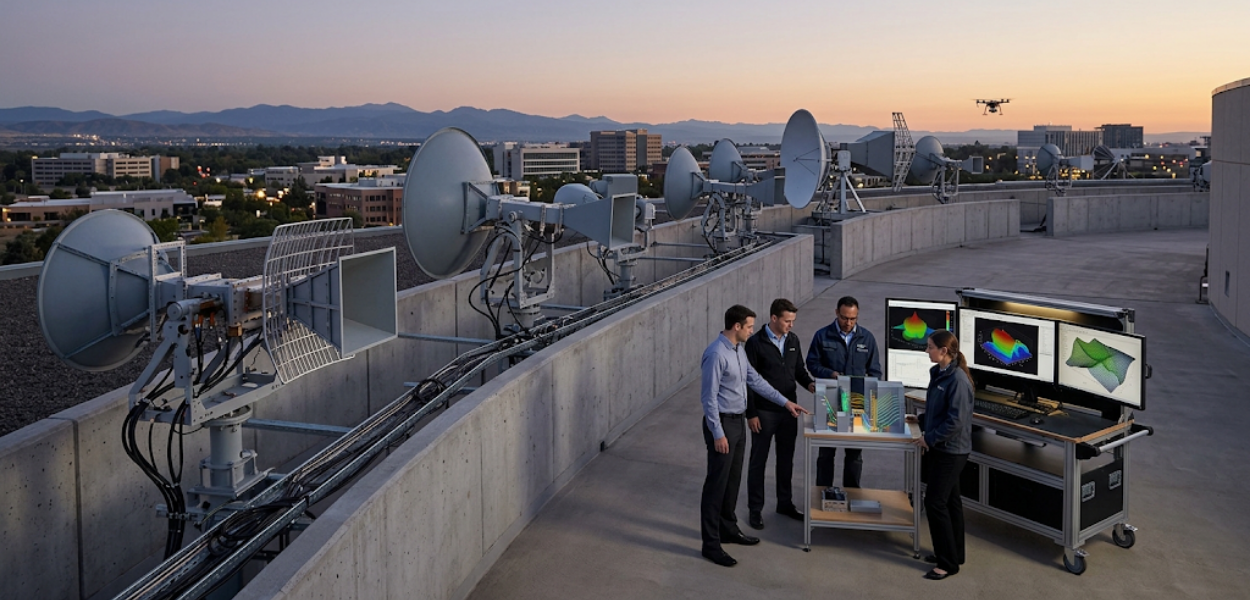
Electromagnetic propagation theory explains how electromagnetic waves travel through free space, air, buildings, terrain, and other physical environments. In corporate settings, this knowledge supports teams responsible for wireless networks, telecommunications, radar, satellite communication, radio systems, antenna engineering, and electromagnetic modelling. Electromagnetic Propagation Theory and Modelling Training Courses provide a structured way to develop these capabilities and connect theoretical principles with engineering decisions.
What workforce problem does electromagnetic propagation training solve?
Electromagnetic propagation training addresses skill gaps in predicting signal behaviour, evaluating coverage, interpreting propagation losses, and modelling real environments so technical teams can improve wireless system planning, reliability, and measurable network performance.
Organisations operating communication systems need employees who understand why electromagnetic signals weaken, reflect, refract, diffract, scatter, or interfere with other signals. A theoretical understanding of electromagnetic waves becomes a practical requirement when engineers evaluate communication links or investigate inconsistent network performance.
Skill gaps often appear when employees understand equipment configuration but lack knowledge of the physical processes affecting signal transmission. This creates problems in network planning, antenna positioning, link budgeting, coverage analysis, and troubleshooting.
Electromagnetic propagation training connects these areas through a structured learning process. Participants study the behaviour of electromagnetic waves and then apply the principles to corporate engineering scenarios.
The subject begins with electromagnetic field theory. Maxwell's equations describe the relationship between electric fields, magnetic fields, charge, and current. These equations provide the theoretical foundation for understanding how electromagnetic energy propagates.
The training then connects field theory with practical propagation models. These models support decisions involving transmission distance, frequency, antenna characteristics, atmospheric conditions, terrain, buildings, and other environmental factors.
For organisations, the measurable objective is better technical decision-making. Relevant KPIs include coverage accuracy, link availability, signal strength consistency, dropped connection rates, interference levels, modelling accuracy, and engineering time spent resolving propagation-related problems.
How does electromagnetic propagation training work in a corporate environment?
Corporate propagation training moves from electromagnetic theory to mathematical modelling, simulation, environmental analysis, practical exercises, assessments, and workplace application, allowing technical teams to convert propagation principles into repeatable engineering methods for planning, optimisation, testing, and troubleshooting.
Training normally begins with an assessment of existing workforce capability. The assessment identifies gaps in electromagnetic theory, mathematical modelling, wireless engineering, simulation tools, and interpretation of propagation results.
The learning process then establishes the physical principles required for later modelling work. Participants examine electromagnetic waves, frequency, wavelength, velocity, field strength, power density, and wave polarisation.
The next stage introduces propagation environments. A free-space environment provides the simplest reference model because the signal travels without significant obstruction or environmental interaction. This foundation supports understanding of free-space path loss.
Free space path loss describes the reduction in received signal power as electromagnetic energy travels over distance. Frequency and transmission distance directly affect the loss. Engineers use the concept when establishing initial communication link budgets.
Training then progresses towards realistic environments. Participants examine reflection, refraction, diffraction, scattering, multipath propagation, atmospheric effects, and terrain obstruction.
Corporate delivery can use classroom workshops, instructor-led online modules, hybrid learning, simulation exercises, technical case studies, and structured assessments. A hybrid programme combines scheduled instruction with digital learning materials and practical modelling exercises.
Case-based learning connects theory with operational situations. For example, a telecommunications team can analyse coverage limitations across an urban area, while a radar team can investigate how terrain affects signal propagation.
Simulation-based learning allows employees to change variables and observe their effects. Variables include frequency, antenna height, distance, terrain profile, atmospheric conditions, polarisation, and environmental obstacles.
Assessment should measure technical understanding and application. Written assessments evaluate theory. Modelling exercises evaluate practical capability. Case studies evaluate whether employees can interpret propagation conditions and select appropriate models.
Implementation becomes more effective when training outputs connect directly with existing engineering workflows. Teams can use the same datasets, propagation scenarios, reporting formats, and technical KPIs used in their daily operations.
Which technical components should electromagnetic propagation training include?
A complete programme combines Maxwell's equations, wave behaviour, free space path loss, reflection, refraction, diffraction, multipath, Fresnel zones, wave polarisation, terrain effects, propagation models, simulation methods, data interpretation, and engineering assessment.
Maxwell's equations form the theoretical foundation. They describe how electric and magnetic fields interact and how electromagnetic waves are generated and propagated.
Wave characteristics provide the next layer of understanding. Frequency determines the number of wave cycles per second. Wavelength represents the physical distance between corresponding points on successive waves. These properties influence propagation behaviour and system design.
Free space path loss provides a basic quantitative model for signal attenuation. It gives engineers a reference point before additional environmental effects are introduced.
Reflection occurs when electromagnetic energy encounters a surface and part of the wave returns into the original medium. Buildings, ground surfaces, metallic structures, and other materials create reflective paths.
Refraction describes the change in wave direction as electromagnetic energy passes between environments with different propagation characteristics. Atmospheric conditions influence refraction and therefore affect long-distance communication.
Diffraction occurs when waves bend around obstacles or spread through openings. It becomes important when direct line-of-sight transmission is blocked by terrain, buildings, or other structures.
Multipath propagation occurs when a receiver receives several versions of the same transmitted signal through different paths. Reflected, diffracted, and scattered waves can arrive at different times and with different phases.
Wave polarisation describes the orientation of the electric field of an electromagnetic wave. Matching transmitter and receiver polarisation improves the efficiency of signal reception. Incorrect polarisation alignment introduces additional loss.
Fresnel zones define regions around the direct propagation path that influence signal behaviour. Obstructions inside important Fresnel zones can reduce link performance even when the transmitter and receiver have visual line of sight.
Terrain modelling examines physical features such as hills, valleys, buildings, vegetation, and surface characteristics. Terrain information becomes important when predicting coverage across large or complex geographical areas.
Propagation models translate physical conditions into mathematical or computational predictions. Different models serve different environments and frequency ranges. Training should therefore teach employees how to select a model according to the engineering problem rather than applying one method universally.
How should organisations deliver and implement this training?
Organisations should combine technical workshops, digital modules, simulations, case studies, assessments, and workplace projects, using a staged implementation model that connects learning objectives with existing engineering tasks, performance indicators, propagation datasets, and operational reporting requirements.
A practical implementation begins by defining the workforce requirements. A telecommunications department requires different competencies from a radar engineering team or a satellite communications department.
The organisation should identify the applications that employees handle. Examples include wireless network planning, radio link design, satellite communications, radar coverage, antenna engineering, spectrum management, and electromagnetic simulation.
The next step is curriculum mapping. Each business requirement should correspond to a measurable learning outcome. For example, a requirement to improve radio link planning can correspond to training in free space path loss, Fresnel zones, terrain obstruction, and link-budget analysis.
Delivery should use multiple learning formats. Workshops provide direct technical instruction. Online modules support theoretical learning. Simulations provide controlled technical practice. Case studies connect theory with operational situations. Assessments measure knowledge retention and application.
Practical projects should use realistic organisational data whenever appropriate. A project can require employees to model signal propagation across a defined terrain profile and compare predicted results with existing measurements.
Managers can evaluate the programme using technical and workforce KPIs. Technical indicators include signal coverage, link availability, interference incidents, prediction accuracy, and troubleshooting time.
Learning indicators include assessment scores, simulation accuracy, completion rates, practical task performance, and the number of employees demonstrating required competencies.
Business impact should be assessed separately from learning outcomes. Training ROI can be evaluated by comparing programme costs with measurable savings from reduced troubleshooting time, improved planning efficiency, fewer design errors, reduced field-testing requirements, or improved network performance.
What benefits does propagation modelling knowledge create for organisations?
Propagation modelling knowledge improves engineering consistency, planning accuracy, technical analysis, troubleshooting capability, resource allocation, and cross-functional collaboration by giving teams a common framework for predicting electromagnetic behaviour and evaluating communication system performance.
A major organisational benefit is improved planning. Engineers can evaluate propagation conditions before equipment is deployed. This supports more informed decisions about antenna locations, transmission power, frequencies, and network configuration.
The approach also improves troubleshooting. When a signal behaves differently from an expected model, engineers can examine physical causes such as reflection, diffraction, multipath, terrain obstruction, or atmospheric refraction.
Training creates consistency across technical teams. Employees using common definitions, models, assumptions, and measurement procedures produce results that are easier to compare and review.
Propagation knowledge also supports resource management. Accurate modelling reduces unnecessary physical testing and helps teams focus field measurements on locations where validation provides the greatest value.
Cross-functional collaboration improves when engineering teams share the same technical language. Network planners, radio engineers, antenna specialists, systems engineers, and technical managers can interpret propagation results using common concepts.
The effect extends to workforce development. Employees gain a defined technical competency framework rather than isolated knowledge of individual equipment or software platforms.
Where can organisations apply electromagnetic propagation training?
Propagation training applies across telecommunications, wireless networking, satellite communication, radar, defence technology, broadcasting, aerospace, industrial communication, and infrastructure projects where electromagnetic signal behaviour affects system design, coverage, reliability, safety, or operational performance.
Telecommunications teams use propagation knowledge to plan cellular and radio networks. They analyse distance, frequency, terrain, buildings, and antenna placement when predicting coverage.
Wireless networking teams apply the principles to enterprise wireless environments. Buildings, walls, equipment, reflective surfaces, and user density influence indoor radio behaviour.
Satellite communication teams analyse long-distance propagation and atmospheric conditions. Propagation modelling supports link planning and performance analysis.
Radar teams examine how electromagnetic waves interact with terrain, atmospheric conditions, and objects. Propagation knowledge supports coverage analysis and interpretation of detected signals.
Broadcasting organisations use propagation models when evaluating radio and television coverage. Frequency, antenna configuration, terrain, and geographical conditions influence service areas.
Aerospace organisations apply electromagnetic propagation principles to communication and sensing systems. Engineers evaluate signal behaviour across different operating environments and system configurations.
Infrastructure projects can use propagation analysis when designing communication systems for transport networks, utilities, industrial sites, ports, and large facilities.
The training also applies to research and development departments. R&D teams need a strong understanding of propagation when developing new antennas, communication technologies, radio systems, and simulation models.
How can organisations avoid common problems with propagation training?
Organisations avoid ineffective propagation training by defining measurable outcomes, using realistic engineering cases, matching models to applications, assessing practical capability, integrating simulations, and measuring workplace performance rather than relying only on attendance or course completion.
A common problem is generic training. A programme covering electromagnetic theory without connecting it to organisational applications creates limited workplace value. Training should therefore connect technical principles to actual engineering tasks.
Another problem is excessive theoretical focus. Maxwell's equations are fundamental, but employees also need to understand how theoretical principles affect propagation models and engineering decisions.
Software dependence creates another risk. Employees who learn only how to operate a modelling tool can struggle when the underlying assumptions change. Training should explain both the model and the software implementation.
A further issue is incorrect model selection. Propagation environments differ significantly. An urban wireless network, satellite link, radar system, and rural radio link require different analytical considerations.
Organisations also need to avoid measuring success through attendance alone. Completion rates show participation but do not demonstrate technical competence.
Practical assessments provide stronger evidence. Employees can be asked to analyse a propagation scenario, select relevant parameters, build or interpret a model, explain the result, and identify environmental factors affecting the prediction.
For teams evaluating advanced applications, the transition from fundamental propagation theory to practical analysis should include topics such as electromagnetic propagation: Fresnel zones, diffraction and terrain obstruction explained. This creates a logical progression from understanding the subject to examining specific propagation mechanisms that affect engineering decisions.
What should organisations measure after propagation training?
Post-training measurement should combine technical competency, modelling accuracy, planning efficiency, troubleshooting time, system performance, assessment results, and business outcomes to establish whether training changed workplace capability rather than simply recording employee participation.
Technical competency can be measured through practical assessments. Employees should demonstrate their ability to interpret propagation conditions and explain the physical mechanisms involved.
Modelling accuracy can be measured by comparing predictions with field measurements. The organisation can track the difference between predicted and observed signal behaviour.
Planning efficiency can be measured through engineering hours required to complete propagation studies. A reduction in unnecessary analysis time provides a measurable operational indicator.
Troubleshooting performance can be measured through average resolution time for propagation-related incidents. A lower resolution time indicates stronger diagnostic capability when supported by comparable incident conditions.
Network performance provides another measurement category. Relevant KPIs include coverage percentage, received signal strength, link availability, dropped connection rates, interference levels, and service reliability.
Training effectiveness should also include assessment data. Pre-training and post-training assessments establish the change in technical knowledge. Practical assessments establish whether employees can apply that knowledge.
Financial measurement can connect operational improvements to training investment. ROI calculations should include programme costs and documented benefits such as reduced field testing, lower troubleshooting costs, improved planning productivity, and fewer technical design errors.
How should organisations connect propagation training with long-term workforce development?
Long-term workforce development should position propagation competence within technical career pathways, combining foundational theory, advanced modelling, practical projects, assessments, mentoring, and continuous technical development to maintain capability as communication technologies and operating environments change.
Propagation competence should form part of a broader technical skills framework. Entry-level employees can begin with electromagnetic fundamentals and basic propagation concepts.
Intermediate employees can progress into modelling, simulation, terrain analysis, link budgets, and practical troubleshooting. Advanced employees can work with complex propagation environments, specialised models, and system-level analysis.
Managers can use competency assessments to identify development gaps. These assessments provide a basis for assigning advanced modules, practical projects, or technical responsibilities.
Continuous learning remains important because wireless systems, frequencies, network architectures, modelling methods, and simulation technologies evolve. A workforce development framework should therefore include periodic technical updates.
Explore More Expert Insights:
RF Circuit and System Design Fundamentals Training Courses
Wireless Communication Systems Design and Performance Analysis Training Courses
The Information Technology and Programming Courses category provides a relevant organisational training context for technical capability development, particularly where electromagnetic propagation knowledge connects with programming, computational modelling, simulation, and information technology applications.
A structured approach creates a measurable progression from theoretical understanding to applied technical capability. It also gives HR managers, L&D professionals, technical managers, and business leaders a clear framework for evaluating whether training addresses actual workforce requirements.